I’m sure most of you might already know but I thought of sharing this. If we are coding for a class library then we should always try to explicitly provide exception type that our code (method) will throw. If we provide exception values in XML Comments then those exceptions will appear in intellisense while we are using that library method. This will be handy for developers using our library. I remember this is also mentioned somewhere in framework design guidelines. - Method definition: Explicit exception details provided
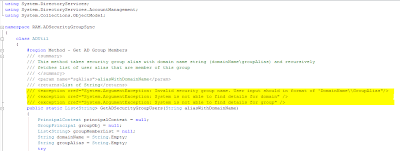
- Method Usage: Intellisense contains list of exceptions
 Cheers!Currently Playing : PROTOTYPE
Few days back while reading about F# I got hold of a nice old article on Functional Programming. Check it out here
I'm on my F# journey from past few weeks. Let us see how far this goes.
Few days back I posted an article on MSDN related to SQL Server 2008 Policy Based Management. Check it our if you are interested in Server 2008 new features.
If anyone asksus , what is C#, what will be our answer? All of us will say, C# is an Object Oriented Language targeting .NET run time. Today this definition of C# is only 10% correct or you can say 10% complete. Surprised! read ahead.
Few days back, I was listening to Anders Hejlsberg's PDC 2008 presentation on C# 4.0. There he formulated a new definition for C#.
C# is a multi-paradigm language that covers functional, imperative, generic, object oriented and component oriented disciplines.
C# 2.0 introduced some concepts of functional languages like anonymous methods and then came LINQ. F#, a pure functional language, makes extensive use of anonymous methods to achieve its goal. C# 4.0 will introduce new features that makes it interoperable with domain specific languages targeting .Net run time.
Some important links:
Currently Listening - Feel the Rush by Shaggy
~eNjOy CoDiNg~


